The Hidden Cost of Over Planning: When Productivity Systems Replace Progress

Planning has become the most socially acceptable form of avoidance.
It looks disciplined. It feels responsible. It produces artifacts, documents, boards, roadmaps, calendars, that signal seriousness without requiring exposure. You can spend hours planning and still never risk being wrong.
That's why planning feels productive even when it isn't.
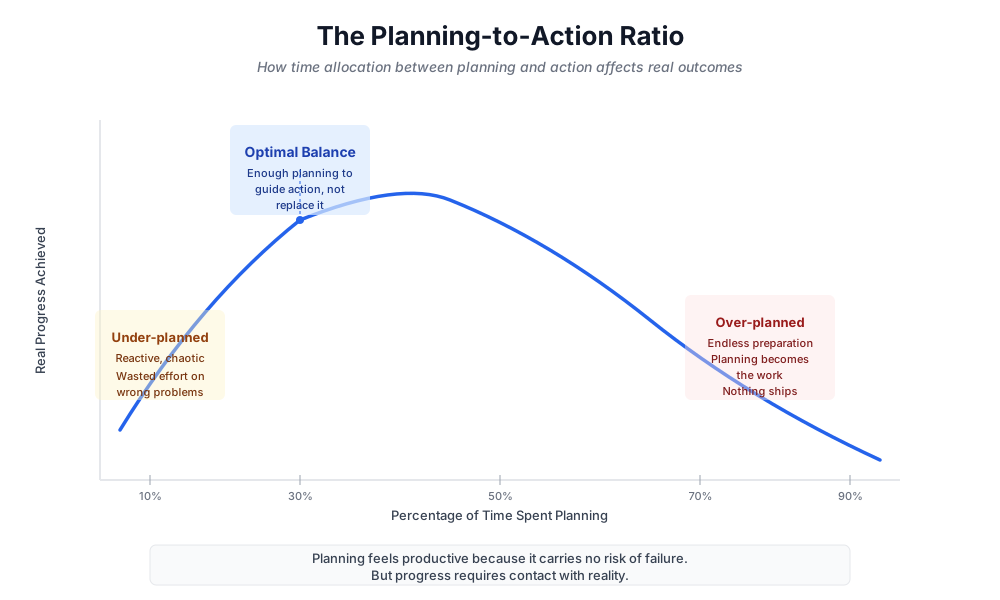
"Planning feels productive because it carries no risk of failure."
Modern productivity culture rewards this illusion. We praise clarity, preparation, and foresight. We rarely ask the harder question: Is any of this turning into action? Or more uncomfortable still: Is planning becoming the work?
When Planning Becomes the Work
For many people, especially knowledge workers and indie builders, planning has quietly replaced progress. Not because they're lazy, but because planning offers control in environments that feel increasingly uncertain.
Action is vulnerable. Planning is safe.
When you plan, nothing can go wrong yet. No one can judge the output. No feedback can invalidate the idea. The system remains perfect because it has never been tested.
This is where over planning becomes dangerous. It doesn't merely delay progress, it trains us to mistake preparation for movement.
The Planning to Action Ratio
One way to see this is through what might be called the Planning to Action Ratio: the amount of time spent organizing, strategizing, and optimizing compared to the time spent actually doing the thing that carries risk.
A healthy ratio isn't zero planning. Planning is necessary. But when the ratio tips too far, when planning expands to fill the space where action should be, progress stalls while effort appears high.
This imbalance is rarely accidental. Planning tools are designed to be frictionless, infinite, and tidy. Action is none of those things. Action creates mess. It produces partial results, awkward drafts, imperfect launches, and uncomfortable feedback.
Planning promises certainty. Action reveals reality.
The Identity Trap
Over time, people learn, often unconsciously, that staying in planning mode preserves identity. You remain "someone with potential," "someone being thoughtful," "someone getting ready." Action forces a different reckoning: you become someone who shipped something that might not be good.
This is why over planning often spikes during periods of burnout, anxiety, or transition. When capacity is low, the nervous system seeks safety. Planning offers structure without exposure. It feels like forward motion without the cost of vulnerability.
The Closed Loop Problem
But systems that over optimize for planning create a subtle trap. They encourage endless refinement without commitment. They turn productivity into a closed loop: plan, reorganize, rethink, repeat.
Nothing breaks. Nothing moves.
The tragedy isn't wasted time. It's misplaced trust. People start to believe that if they can just find the right system, the right template, the right workflow, the right app, progress will follow automatically.
It rarely does.
What Progress Actually Requires
Progress requires contact with reality. That contact is inherently uncomfortable. No system can remove that discomfort without also removing the progress.
This doesn't mean planning is bad. It means planning must be constrained. Healthy systems create pressure toward action, not infinite preparation. They limit how long planning can remain abstract before something concrete must happen.
The most effective frameworks treat planning as a short prelude, not a destination. They measure progress by exposure, not organization. By attempts made, not plans perfected.
When Planning Becomes Performative
When planning replaces action, productivity becomes performative. It looks impressive from the outside and feels busy on the inside, but nothing compounds. No learning accrues. No momentum builds.
This is why some of the most "organized" people feel the most stuck.
They haven't failed to plan.
They've planned too successfully at the expense of risk.
The Uncomfortable Truth
The quiet truth is this: if a system never forces you to confront reality, it will never produce real change. Planning should make action clearer, not optional. It should narrow choices, not multiply them. And it should end the moment it stops serving movement.
Otherwise, productivity becomes a mirror, reflecting effort back at us, instead of a bridge that carries us forward—and the contrast case is planning that bends without breaking: same uncertainty, less rehearsal tax.
The Turning Point
Progress begins when planning ends.